
Invisible Giants: The Billion Dollar Tech Companies You’ve Never Heard Before
When we talk about big tech companies, we normally gravitate toward household names, like Nvidia, Google, and Apple. Sure, these trillion-dollar companies have more than earned their places in the public consciousness and defined this new digital age that we are all living in, with their groundbreaking hardware and digital tools. But the downside is that they take a lot of attention away from some other major forces in the tech world.
It’s crazy to think that, hidden just below the surface of big names, there are actually over 1200 billion-dollar tech companies in the world, and each one is capable of building systems and infrastructure that make our modern world go round. So, without any further ado, let’s take a look at some of tech’s biggest unsung heroes and give them a taste of the limelight.
The Business Behind the Chips
We’re so used to attributing the credit for smartphones and personal computing to the major players like Apple and Microsoft that we don’t give a lot of thought to the companies that power the products themselves.
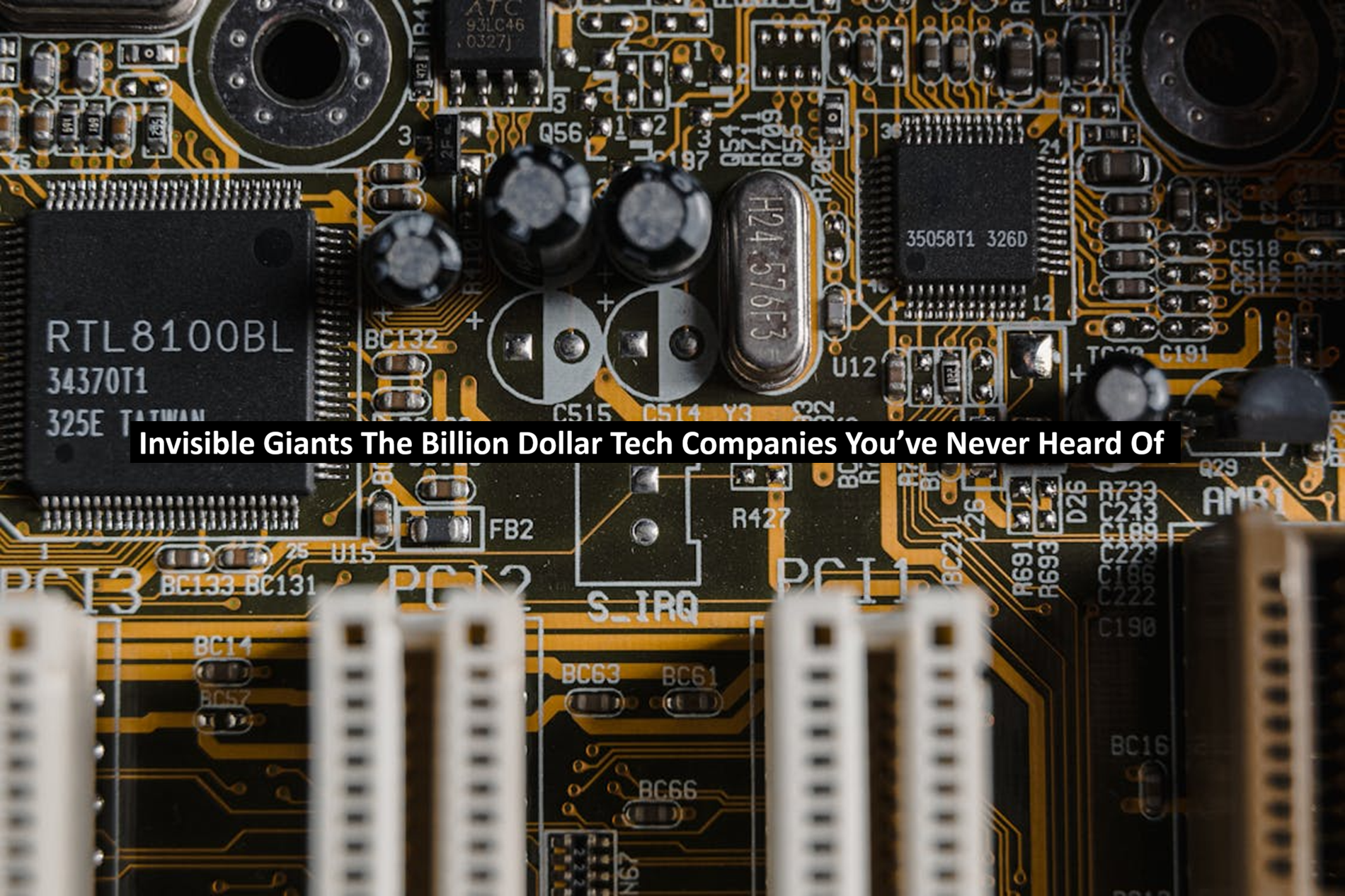
The beating heart of every smartphone, server, heck – pretty much every modern electronic device – is the semiconductor chip. Making them isn’t easy. Not only are the resources required scarcely available, but making the chips themselves takes an extraordinary level of precision.
That’s what makes ASML all the more impressive; they’re the world leader when it comes to photolithography systems, which, to you and me, are the machines that mark tiny microscopic patterns onto silicon to make chips.
ASML’s EUV (extreme ultraviolet) lithography technology has proven to be one of the biggest leaps forward in chip manufacturing. These groundbreaking machines are so advanced and difficult to construct that only a handful can be constructed every year, and each costs hundreds of millions of dollars just to make.
Even though ASML plays a vital role in the global tech economy, they are still largely invisible in the eyes of the general public. That’s probably because its customers are other corporations, not consumers, and its products are put to use deep in manufacturing processes, away from the eyes of most people. Yet, without ASML, this rapid advancement of computing power that we’ve grown accustomed to would completely stall – grinding almost everything, from AI data centres to transport systems, to a halt.
Read: Why Micro Personalization Tactics are the Secret to Better SEO?
Digitising the World’s Water
When we talk about tech nowadays, the focus usually lies in consumer electronics and AI. There’s nothing explicitly wrong with that per se, because that’s how most consumers interact with it, but it means that we don’t acknowledge companies that operate in the water infrastructure industry.
Although water infrastructure isn’t often the topic of conversation, it has been a massive area for innovation over the past ten years or so. These companies specifically focus on areas like water transport, treatment, and conservation – their strength being their ability to integrate digital tools in traditional (typically outdated) systems.
But on top of that, similarly to ASML, water tech and infrastructure companies are innovating the manufacturing process of semiconductor chips. Their ultrapure water is needed at nearly every stage of the manufacturing process, as water that isn’t from an ultrapure source has high levels of total organic carbon, which can negatively affect products and damage industrial machinery by leaving residues on components that can lead to defects.
These businesses are best known for their essential water infrastructure systems around the world, as cities rely on their systems to have access to clean water and to properly process wastewater.
Cybersecurity Agents
In this day and age, the demand for high-quality cybersecurity systems has gone through the roof, as more complex security risks threaten ordinary people and businesses everywhere. Fortinet offers a range of services that can protect networks and devices from potential threats. This includes solutions like firewalls, intrusion detection systems and secure access technology.
What makes Fortinet more successful is its ability to combine different security functions into a single system as a single offering. This is much easier for corporations that require protection for both security and GDPR compliance, and can take a simple package that covers all of their bases.
Because cybersecurity operates in the shadows and out of sight, and is used by businesses rather than individuals, it usually isn’t the topic of conversation – well, unless something goes horribly wrong. But Fortinet’s success emphasises the necessity of cybersecurity in a modern digital world that’s only becoming more and more connected.
Conclusion
These companies may not get the credit they deserve for the impact they have on our modern world, since their innovations don’t rely on consumer visibility and brand recognition. Whether they build chips, manufacture ultrapure water, or protect us from invisible threats, the focus of these companies is firmly on solving difficult problems to make billions of lives easier.